

The Design Is Never Negotiable. The Fit Always Is.
A design is born before it finds its body.
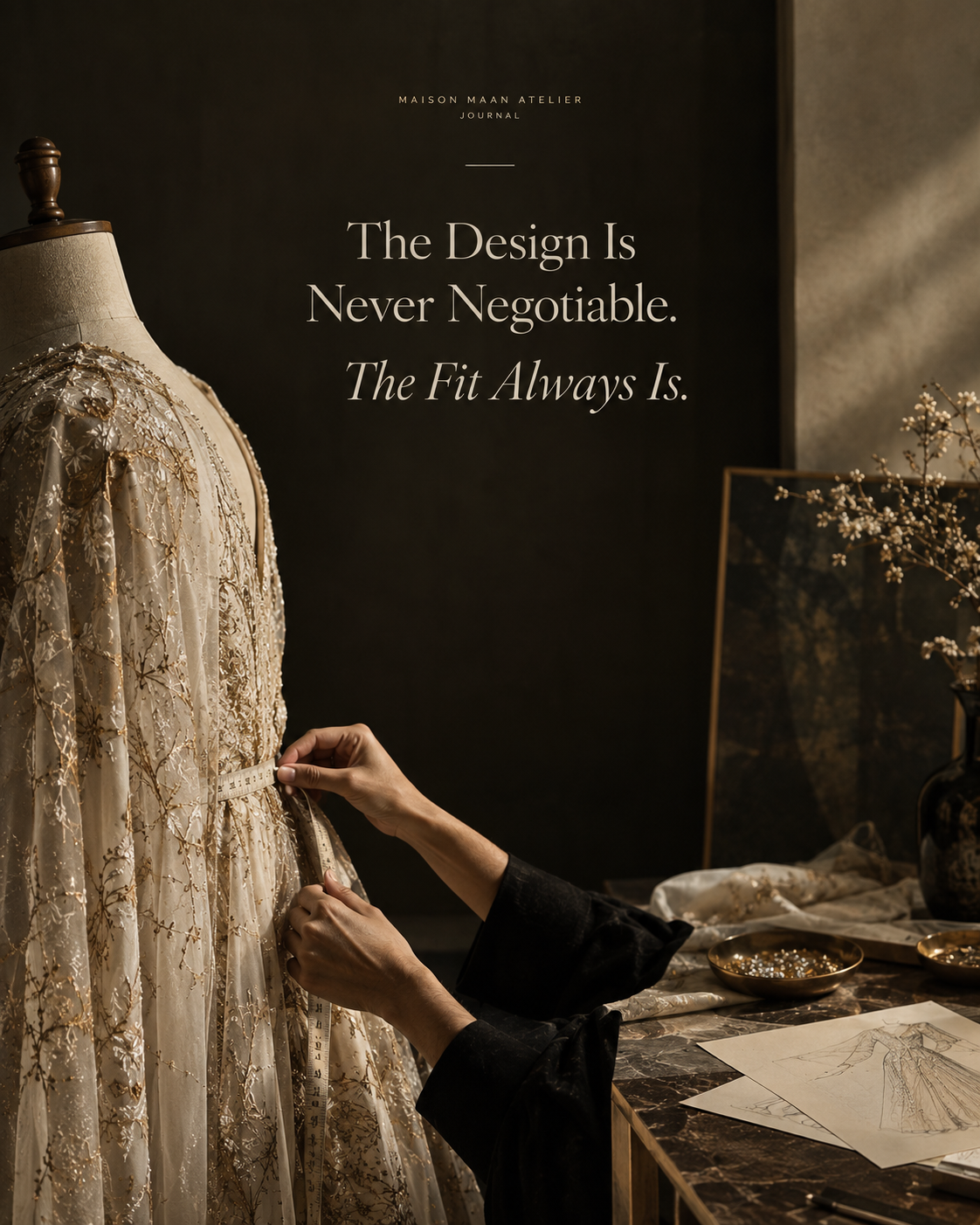
The House’s philosophy of design: the piece remains true to its origin; the fit is made entirely for the wearer.
Long before a canvas is stretched or a first line is drawn, a painter is already responding to something — a mood in the air, a memory that won’t settle, the noise of the world just outside the studio door. No one commissions that first impulse.
It arrives on its own terms, shaped by an artist’s awareness of everything happening around them: culturally, politically, economically, environmentally. Only once that impulse resolves into form does anyone else enter the picture.
At Maison Maan, the Gown Begins Before the Client
At Maison Maan, a gown begins the same way.
Before a client exists, before there is a body to dress or an occasion to plan for, there is already a piece. What gets made in that space — no request, no reference, no one to please — is not really a garment yet.
It is closer to an aura: the presence of someone alive to more than themselves, attuned to the culture around them, to politics, to economics, to the state of the world they move through. No design here is one idea in isolation. Each is the residue of countless lives that have converged, knowingly or not, to leave a single mark on history — and it is that convergence, not a client’s wish list, that pulls the work toward form. A painting. A gown. The object always arrives last. The awareness arrives first
The Work Before the Service
This is the part of the process most fashion houses skip past on the way to talking about fabric and fit, because it is inconvenient to a service model built on saying yes. But it is the whole point, the same as it would be for any working artist: a piece that begins as someone else’s request will always carry the fingerprints of that negotiation.
A piece that begins as an aura carries only itself — which is precisely why, when the right person finally meets it, something closer to recognition happens than a transaction.
Recognition Before Conversation
It happens fast, and it happens visually, before anything is said aloud. A small edit is offered — three pieces, usually, laid out with no explanation needed — and one of them speaks before the others do. Not because it flatters on sight, but because what’s standing in front of the client was never only stitching. It’s history, culture, and the present moment, woven into a single amalgamation of thread. Looking at it, they find their protagonist — the version of themselves they have always known they were, long before this piece existed to prove it.
What Follows Recognition Is Measurement
What follows that moment of recognition is not design. It’s measurement.
This is the distinction Maison Maan asks its clients to sit with, and the one most bespoke language obscures. You do not ask a painter to repaint a finished canvas so it matches your living room. You buy the painting for what it already is, and you decide where it hangs, how it’s lit, what frame lets it breathe.
Personalisation was never supposed to mean rewriting the idea. It means resolving it — precisely, physically — to one particular body. Ask to change the piece itself, its construction, its fundamental shape, and something is lost that has nothing to do with craftsmanship and everything to do with origin. The feel, the original thought, the concept undiluted — all of it lives inside a design’s construction the way a voice lives inside a sentence’s structure. Alter the structure, and you haven’t customised the sentence. You’ve written a different one, in someone else’s hand holding the pen.
Everything Around the Garment Can Move
That said, the House is not interested in rigidity for its own sake — only in protecting the one thing that actually matters. Where the piece itself does not move, everything around it can. A cape, a set of gloves, a cloak, a headpiece: these can be shaped collaboratively, built around an occasion, a mood, a wish the client brings in. It is the House’s task to render them so they honour the original design while still making the full look unmistakably the wearer’s own to style. The garment holds its centre. Everything orbiting it is negotiable.
The Body Is Where Bespoke Begins
And then, finally, the part that is genuinely bespoke — not the idea, never the idea, but the fit.
Bodies are not made to spec. No two are built the same, which means no two can reasonably be expected to answer to the same construction fundamentals, however elegant those fundamentals are on paper. A hem falls differently on every pair of hips it meets. A shoulder seam that sits perfectly on one frame will sit like an apology on another.
This is not a flaw to be minimised in bespoke fashion — it is the entire reason bespoke exists. The body is a temple, and deserves to be treated like one: measured with the same seriousness a design was once dreamed with, and adjusted until the two finally meet in the middle.
When the Garment Becomes Skin
It is only at that point — proportion resolved, not concept altered — that a garment stops behaving like clothing and starts behaving like skin. And it is only then that the recognition which first drew someone to the piece is finally completed: the protagonist they saw reflected in it becomes the exact shape they occupy, in the exact room they are standing in.
This is the moment a person is not simply wearing an idea anymore — they are meeting themselves inside it, made suddenly, physically, undeniably visible.
The Offer
That is the offer, stated plainly: the design was never yours to change, and it was never meant to be. It knew you before you knew it — and it was only ever waiting for you to grow into the shape it had already imagined.

